

AWP26 (Baltimore) Recap
Small Moments, Exhaustion, Togetherness, Merch, Overwhelm, Abundance, Merch, Oh and did I mention Exhaustion?

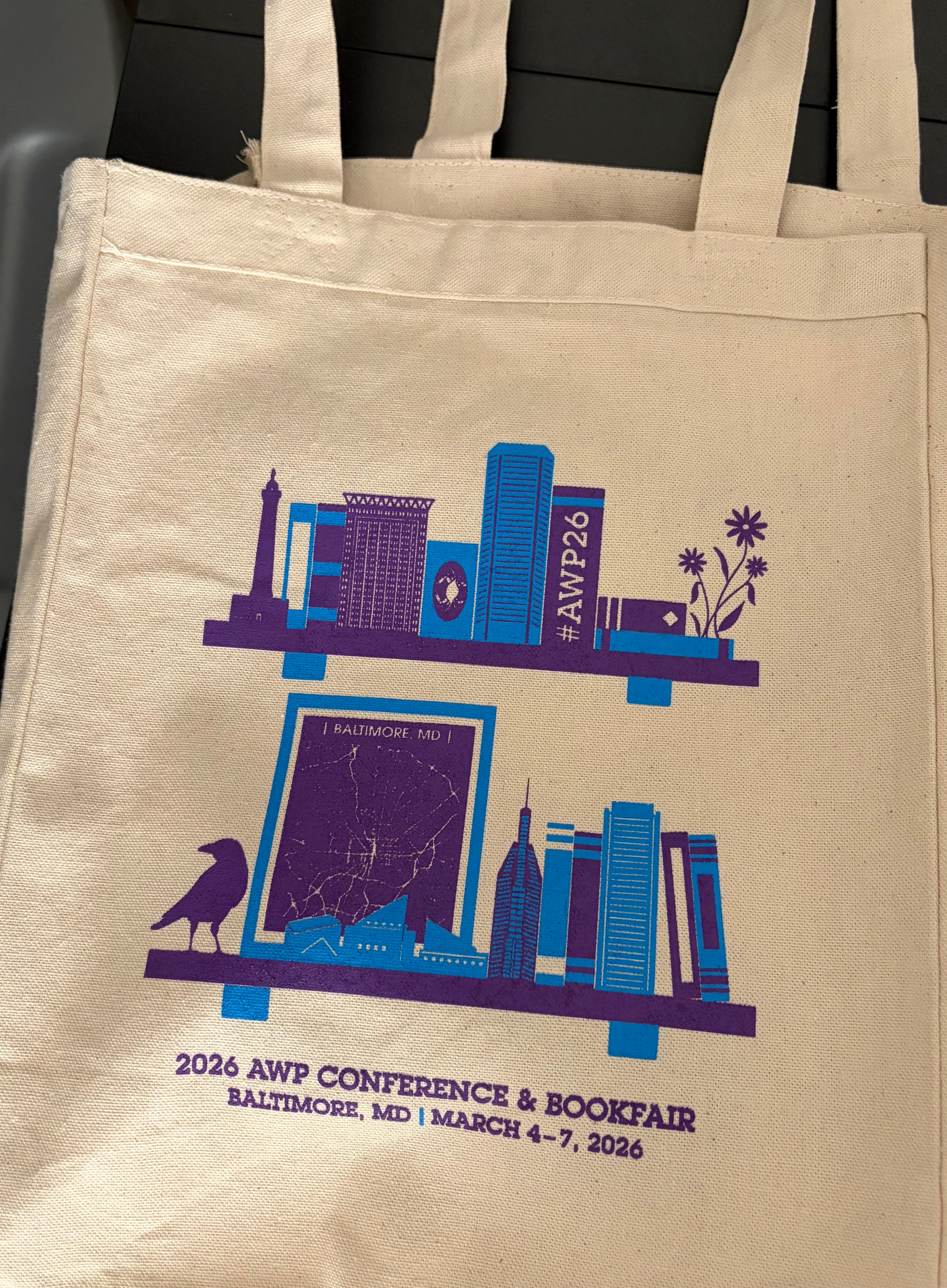
I want to regale you with tales of HST gonzo-style escapades but, well, that just not my life these days.
Overall, I’m confident Louisa agrees that we had a good experience at AWP this year. Louisa did her own thing for part of the time and so I won’t put words in her mouth.
Donna Hilbert and I had a lovely time paling around! It was our first time meeting up in person and it was a real joy to hang out and chat over the course of several days of trade show madness.
I know a little more about trade shows than I did the first time I attended AWP in 2017 in Washington, DC. This is because one of my temp freelance gigs involved quite a bit of research about the in-and-outs of trade shows. For one thing, it led me to realize that I’d been to one. AWP is advertised as a “conference” because literary community folks are kinda allergic to thinking that sound corporate-y or specifically about money or specifically about networking (again corporate-y). So, I can tell you that a lot goes into making a trade show come together—boatloads of moving parts in the pre-conference stage, leading up to the event, during the event, and post-event (benchmarking, accessing ROI, basically figuring out if it went well and trying to determine how to do better in the future). Some of this is wrapped up in the MFA industrial complex since AWP is tied to writing programs. They go by AWP instead of The Association of Writers & Writing Programs kinda like AFI goes by AFI instead of A Fire Inside … Let’s be real, it was more important for AFI.
AWP offers an opportunity to see literary community folks that I primarily (or exclusively) only see online, on social media, engage with via emails, or get to see through the (frankly amazing) modern technology of virtual spaces (Zoom, etc.). In-person (IRL) is just different. I know this, even though I sometimes try to convince myself otherwise.
AWP is an expensive endeavor. It wasn’t cheap even when it was in Philly (AWP22), which was local to where I’m currently situated.
Projections indicated that AWP26 would have about 12,000 attendees which is 5,000 more than AWP22. This is partly to do with it being a number of years “post-pandemic” and partly to do (I suspect) with nearby access from East Coast / Mid-Atlantic major cities (NYC, Philly, DC) and simply large densely populated areas lousy with writers.
AWP is exhausting. This is well-known. It’s a well-known thing about all trade shows, actually. Contemporary trade shows usually have lots of protocols in place to prevent burnout and, notably, AWP actually doesn’t seem to focus on this much at all. They had a Quiet Zone (or something of that sort) that was allegedly sensory-friendly. That sounds great and up my alley except it’s hard to get yourself to actually make use of something like that when you’re in the belly of the beast (shout-out to HST). It’s also notoriously hard to feed and water yourself.
When I went to AWP in DC that was a major issue. I was tagging along with a group of MFA kids (er “students”) and we were not real adults with any sort of money to burn. This is a problem. Everything onsite at a trade show involves price gouging and restaurants in close proximity may also be rather expensive because they know their audience and they know their audience has limited options. Basically, legally up charging people for an umbrella when it’s raining. Water? $4. Sandwich? $20+. And so forth.
Baltimore was not prepared for this. It felt like giving the Olympics to a city that couldn’t afford to do it right. I’m slightly overstating this. This city itself is clearly struggling and I don’t mean to blame the victim. Overnight, it felt like sirens were going every 20-minutes. Almost everywhere we went felt between moderately unsafe to definitely unsafe. Philly has pockets that feel more safe today, and Philly feels less safe than the two periods of time I lived in the city. That is to say that Philly has areas that feel quite safe whereas there weren’t areas of Baltimore that gave me that level of ease. This being said, Baltimore is not my city and so, unsurprisingly, I’m going to feel unsure. Cities are, by nature, “block to block” when it comes to safety and I’m the kind of person who gets lost in their own backyard… which means it all too easy for me to find myself in a place that doesn’t feel like an ideal place to be. Not trying to let Baltimore off the hook entirely but I also don’t want to tell you it’s not safe to go to Baltimore because I’m sure it is if you’re attentive and savvy and go to reasonable places during daylight hours.
The small moments of joy involved an abundance of chance encounters with poets and writers at the bookfair or wandering the conference center or even at the hotel where we were staying. There were memorable non-awkward moments in the elevator at the hotel. There were exuberant sighting and lots of hugging when I arrived at readings and had the opportunity to support poets I love and admire at in person events. Shout-outs to Kai Coggin, Hayley Mitchell Haugen of Sheila-Na-Gig, Passager and Bracken lit mags, just to name a few.
I attended a powerful reading and conversation between Richard Siken and Gabrielle Calvocoressi moderated by Michael Wiegers (Copper Canyon Press). Richard really has a way with words. Gabrielle has a stage presence that reminds me of David Sedaris in certain respects. Michael Wiegers is evidently quite an impressive steward of the arts.
I was glad to hear Vauhini Vara speak in person on a panel about AI. Vara is the author of Searches: Selfhood in the Digital Age which was on my list of favorite nonfiction reads of 2025. The conversation was interesting and thought-provoking though it was clearly for a more mainstream audience and lacked nuance about the future of AI technologies. I don’t posit myself as a techno-optimist though this conversation felt a little one-sided. An important takeaway was that large multinational corporations are not in the habit of putting out products that are in the best interest of users; of course, they are profit-seeking entities that prioritize making money hand-over-fist and will absolutely destroy the planet in the name of yielding optimum shareholder value.
The first panel I attended was really the sweetest and a nice way to start the conference. I also got to see out-of-town literary buddies who, of course, would be at an event honoring Richard Peabody’s 50 years of dedication to the literary community through Gargoyle magazine. 50 years. Stunning. Full stop. Gerry LaFemina did a great job moderating and Rita Dove was even one of the wonderful panelists!
The old AWP reputation was that the name checkable folks did not show up for their panels. Based on what I’ve heard so far, that was very much not the case at AWP26.
Many, many people came up to me during this convention and offered praise which I certainly did my best to let soak in. Many also were confused and somewhat saddened and somewhat confused that ONE ART did not have a booth. In hindsight, this would have been a good year for a booth if for no other reason than my body isn’t cooperating and less standing would have been ideal. Don’t worry, I’m looking into what it will take for ONE ART to have a booth for future conventions. And there will be merch.
*
Let’s talk merch.
I mentioned doing freelance work that taught me a little about trade shows. Well, long before that, I held a job for about a decade that also taught me a bit about merch. Every year we’d do this golf outing and I was partly in charge of deciding what merch we were hand out. Because we were dealing with corporate types, the goal was to think of items that someone might actually keep on their desk. The idea being that if it was regularly on their desk this would act as a reminder that “Hey, I should throw them a little business.” Cool. That’s not necessarily how it works for writers/editors/publishers. This requires a different approach to marketing, branding, promotion— advertising. Do I know what works? Not really. But I’m going to talk about the merch that ended up coming home with me and reflect on whether or not these are “impactful” so to speak.
Bookmarks.
Bookmarks make sense since we’re talking about the small percentage of the population that actually read books. They’re also cheap to get printed. You can get a ton of them and they can look pretty cool and you can give them away or sell them for $1. I’m in favor of giving them away, just to say.
Maybe say something quirky and unique but don’t forget to also put the name of your lit mag or press on it. There are definitely some that don’t say who or what they are affiliated with and while this might make for a nicer art object it totally misses the objective of getting people to remember your organization. Keep in mind, this is about marketing.
Stickers.
I lean toward the ones that someone actually wants to put on something as opposed to ones that are instantly obsolete after the trade show ends. There were some stickers that were kind of like mini posters for events taking place at the conference center or off-site and this struck me as a bit unnecessary and a little wasteful. In the context of merch, wasteful feels like something you might eyeroll at because most of the giveaways are technically wasteful of resources (in more ways than one).
Earlier, I dropped a sticker on the floor that fell out of the annual AWP tote bag that was advertising a lit mag and a podcast.
I’m not 22 so I’m not going to put random stickers on my laptop.
Bags.
There weren’t as many random tote bags being given away. In fact, I barely saw any and those I did see were not free. This makes sense since AWP was giving away a bag and you don’t need to double down. Also, the tote bag thing is a bit tired these days unless you’re a major entity such as POETRY (magazine), The Paris Review, The New Yorker, etc. People like these as statements but they don’t want to advertise for Local River Mountain Review (sadly, we must admit reality checks).
Postcards.
These are like bookmarks that maybe, if you’re lucky, someone will put on their fridge or tack on their corkboard. I think that’s the goal here. Good for, you know, informing folks that you have an upcoming contest or award and such and such is the deadline.
Poker Chips!?
This was new to me and I like it. Or, I really thought it was super cool until I saw more than one table had them. Then I realized it was a product that was readily available and not bespoke or anything like that.
QR Codes.
Useful, I suppose, but everyone hates them. I’m not sure what to do about this.
What’s worse than a QR code? A QR code that will eventually go to a dead link.
Mini Notebooks.
A win. No question. The Writer’s Center was giving these little knockoff Moleskine’s away and they were instantly useful. I would recommend this to anyone. They might get used and buried in a writer’s drawer but they will be unlikely to get thrown away. That’s the key. Someone might dig it out of their drawer to take notes at a reading years later and then look your organization up again or it can remind them that they love what you publish and read your magazine and want to submit. Seems worth the cost.
Post-It Notes.
Old school charm.
I’m a fan.
I don’t know how effective this is in modern times but, generationally, I’d say this is a win for anyone millennial or older.
Reflect on your demographics.
Pens (and pencils, I suppose).
A classic.
They are cheap even if they seem pretty fancy.
Recommended.
Interestingly, I didn’t see a ton of pens being given away compared to past events. Maybe prices have gone up? Maybe they seem unoriginal? I dunno. In any case, I wouldn’t give up on this classic trade show giveaway.
Buttons.
Kinda cool, sure.
Part of the problem is post-event I don’t think many folks are going to keep these on their clothing.
Knickknacks.
Cute. Often very cute.
Some appear rather expensive and more for the shock and awe effect.
Might play well during the event but I can’t see this stuff being used or left in plain view after the show is over.
Keychains.
A dark horse candidate for a wise choice in merch. Up there with bookmarks, pens, notepads, and Post-It notes.
If you get lucky, someone actually puts this on their keys.
Again, they’re unlikely to do so if it’s something that they don’t love because people might actually ask them why this thing is on their keychain. This goes for a lot of merch, in fact. Keep in mind that someone has to be cool with others (notably non-literary folks out in everyday society) asking questions and being willing to come up with an explanation that doesn’t feel awkward or otherwise embarrassing.
I’m not going to walk around advertising a rando MFA program, for instance, or repping an organization that I don’t particularly respect.
Poet/Writer Baseball Cards.
I have to say that I love these. And the writers must be honored. I think it’s a great idea even if they end up lost in a drawer because for at least a little it’s going to make some people very happy. Worth it for the smiles and sense of validation.
I recommend more promo items like this. Items that can double as “merch” but are really more of a keepsake. That are more than just an ephemeral thing, briefly glanced at, possibly enjoyed momentarily, that is most likely going to end up in the trash.
Rejection Bingo Cards.
A few tables gave these away. Chill Subs has a high quality one that is well-aligned with their general vibe and aesthetic. They are really good at this game and they know it.
As much as part of me doesn’t love promoting collecting rejections (because it may make my life a bit more difficult), it’s making something painful (rejection) more tolerable and, thinking about merch, it’s something that people may actually keep on hand for a while.
*
Outshot?
There is no logical way to end this, is there?
As stated at the outset, conventions like AWP (ahem, trade shows) are exhausting. They’re an experience. They’re educational (if you wish). They’re immersive (this could be taken many ways... if you went to a different type of trade show in recent times there would be an emphasis on Virtual Reality (VR), Mixed Reality / Enhanced Reality) and other technologies sold as “cutting edge” as ways to encourage engagement). They’re fun, at times. They’re depleting both physically, and psychologically, and because you’re probably not fully doing the real type of self-care due to lack of access to healthy or quality foods and snacks and budgetary restrictions. Let me pause here to emphasis that being thrown out of your routine is tough. I heard a lot of joking-not-joking talk of AWP being a space where you throw a bunch of awkward introverts together and see what happens. It’s kinda true. On a positive note, it goes better than one might expect. In some moments, much better.
*
Notes:
This is not a comprehensive overview of my AWP26 experience.
I was going to add a “quick shout-out” to some of the many poets and writers it was a joy to see in person but worry about people feeling left out and so decided against it. If I saw you at AWP please know it was delightful and memorable for me.
*
I'm glad you said it was depleting because I thought it was just me getting old (I am old). I had nice conversations and the few panels I managed to get into (so many were "sold out"!!) were interesting but I was utterly exhausted at the end of each day. Offsite events? Hahahahaha! The one I was dying to go to was a $38 Uber ride ("surge pricing") so, after spending $5.20 for 10 oz of water, I stayed in. This was my first AWP because I was never in an MFA program, and it will be my last. I enjoyed it intellectually but physically it was like being beaten up.
I enjoyed your AWP recap; thanks. I especially liked "large densely populated areas lousy with writers" and your statement that you tend to get lost even in your own backyard. The only AWP I ever attended, even in part, was last year in Los Angeles, when I went for half a day on the last day, and had a good time. I met a number of writers I'd not met in person before, and Scott Ferry led me around to some of his favorite booths, which was fun. Being me, I carried my own water and peanut butter sandwich and avoided the expensive food and drink on offer. Even that half-day was exhausting and overwhelming, but interesting; I was aware that I was missing out on the kind of camaraderie that could develop from being at the conference for the whole thing.