GrantAIgate: Taste, Subjectivity, & Art
Granta Scandal & AI Panic in The Literary Community

(Note: I have plenty more to say but the following is already a long read. So, I’ll leave it at this for now and will eagerly await feedback from other humans.)
*
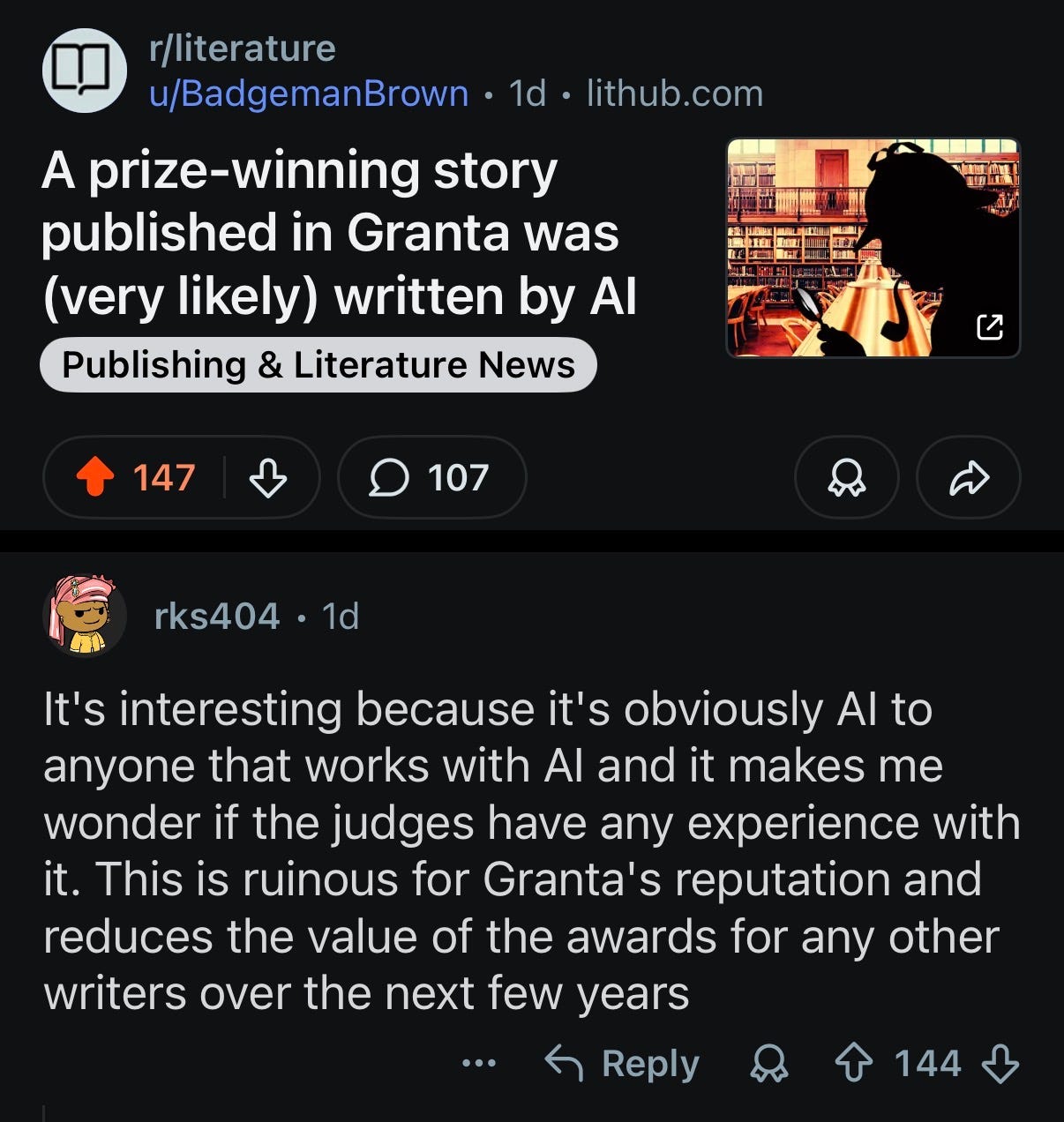
Granta published a story. It turns out it may well be, at least in part, AI-generated. That is, AI may have been used in the writing process. Many readers, commenters, AI experts, even AI tools themselves, point out instances in the work that follow common tropes or techniques that have been noticed in AI-generated or AI-assisted work.
Here’s the thing that many have also pointed out— AI was trained on writing by people. In turn, these are writing techniques that people actually do use.
I first shared about my concerns on Facebook, in part, because I wanted to see what the hive mind (of real people) had to say. The literary community has been understandably upset and fearful about AI tools.
+++++
Let me say here, up top, that this is not an enviable position to be in for Granta’s team. I feel for them.
Frankly, I hope Granta’s team are steeling themselves and focusing on the serious components of the task at hand and not reading the comments. We know by now that it’s best not to read the comments. Not that feedback is unwarranted but, you want balanced and good-spirited feedback from people who mean well and wish to help. Not drag you down. As a long name-checkable prestige lit mag, Granta is an obvious and easy target. Because of their stature, this makes them fair game in certain respects, but it doesn’t mean we should take cheap shots.
Some may already be aware of the “Shy Girl” scandal not long ago. It was pointed out that the industry new this was coming and the question was really who it would happen to first.
+++++
Here are a few lines from the story that have raised eyebrows:
“Not the bees’ neat industry or the clean rasp of cutlass on vine, but a belly sound – as if the earth swallows a shout and holds it there.”
“No fan, no bulb, no hum – only the thin light slipping between warped boards and the breath of hills holding their heat like a secret.”
“Hard living lays itself on a man like wet sacking; it never asks permission.”
“Coins meant for rice or kerosene slid across the counter and came back white rum hot as apology. One drink opened the chest, two turned fear into courage’s cheap cousin, three steadied the hand enough to write the future in invisible ink.”
“She had the kind of walking that made benches become men.”
“He saw all of it in a knife-second.”
+++++
Here’s what I wrote on Facebook:
A fear I have with the Granta situation is that lit mags / publishers will be further disincentivized to pay authors
It’s hard to argue that there aren’t reasons for distrust, but it’s writers who will suffer from this (as if they are not already losing $ due to AI)
+
I followed up with several comments and then responded to others as well, which was a help, and more naturally human way of going about thinking through this.
I added:
Beyond lit mags & presses… contests, awards, residencies based on work samples…
Book contracts are presumably getting very uhh thrifty and less writer-friendly… can see a publisher quickly insisting to be reimbursed for a (what do you even call those… oh yes) … an advance (do poets even receive these)
+
This relates to the Granta scandal and the literary community (and academia and science all dealing with worries about AI cheating):
The [AI detection] software is still way too fallible. Too many false positives saying heavy AI use. I’ve heard plenty of claims against this for tools like Pangram but writers have showed time and again with creative writing these tools struggle to discern language produced by LLMs from natural human writing. Partly because the models have been fed so much human writing and partly because our idiosyncrasies and not all that different from the ones people associate with AI writing (like overuse of the Rule of Three).
+
Important to keep in mind that current Generative AI models (LLMs) are simply predictive (our brains (small language models)) do this to an extent as well. They know all the things (or think they do)... easy bias and fallacies and problems of omission related to thinking along the lines of Rational Choice Theory (RCT) [and cost-benefit analysis]. They have an “unknown unknowns” problem.
+++++
The problem with AI tools is a little like the problem some have noted with Tech Bros using psychedelics— you’re not putting in the legwork and that’s where we come to understand and internalize and have real breakthrough and epiphanies. The process of synthesizing requires thinking, reflecting and often reading, and certainly doing our own research, and coming to our own conclusions. And then being willing to maintain a certain level of receptivity so that we can update our knowledge base when we come across new information. AI tools can allow us to dismiss all the standard steps, avoiding anything like synthesis or breakthroughs, and take us right to the end game. This can expedite things but, of course, there are many many downsides.
I just read an archeologist’s opinion that T-Rex may have had tiny arms because of a “use it or lose it” evolutionary theory. Well, at the rate we’re going… there’s a lot we are surely at risk of losing.
The alarm bells are already signaling that it’s essential people, especially readers and writers, but really anyone who wishes to be literate, ought to be very careful about what they are willing to allow themselves to offload to their AI “interns”. The issue is that cognitive offload means we’re not exercising our muscles in these areas and, as we know with real muscles, this means they will atrophy. Our writing chops, as well as our critical thinking will deteriorate, if we are not constantly using these skills and honing them. There’s a reason writers are encouraged to write regularly (if not daily) and the read even more than they write. Things become like muscle memory, natural (if you will), the more we practice them. Practice matters. If you show up on game day without having practiced you are unlikely to miraculously display peak performance.
+++++
A few good excerpts from Facebook comments:
Kat Lehmann: “I know very little about this but find it concerning nonetheless. The few AI poems I’ve read have had a soullessness to them, but it certainly wasn’t something quantifiable. Humans can write soulless poetry too. Humans can write bad metaphors and steal lines. So then how is AI poetry distinguished from bad human poetry? Does using a bad metaphor put our poem into question?”
I replied: We’re out of our depth for the time being. In reality, I don’t know that we can tell the difference. We want to believe we can. It’s only natural.
+
People are looking for reasons to not have to concern themselves with big name “prestige” lit mags.
Dorothy Potter Snyder: “More reasons to distrust Granta, in my opinion. I have long thought that the so-called prestige magazines— including The New Yorker and Paris Review in this—have lost any kind of mission to publish literature that connects with anything close to a general reading public. Reading them has become more and more like going to a jazz club where the musicians are clearly just playing for each other, but without any drinks. If the editors cannot tell that a story was written by AI, why should I think they have any idea what good literature is? Magazines that have real editors with taste will not stop paying writers because of this. Actually, because of this, we might start seeing writers (like me) care less and less about the prestige lit mags.”
+
Rita Quillen: “My question has always been: if they fed our work into AI to teach it all it knows about writing, then our next manuscript is fed to an AI detector.....what a horrible twist of fate if AI then declared that all your actual original work “sounds like AI”.”
+++++
A few more of my thoughts/commentary on this and related AI matters…
Gen AI LLMs… will likely think they will know what you want (depending on data about you they have)... I say think but they do not “think”. They crunch data. They don’t feel either... but alas we will likely not be able to tell the difference there either soon enough. This doesn’t mean we treat them as sentient or give them rights. That’s a whole separate discussion about social contracts. I digress. ... it’s all going to get quite weird (though “interesting”) for a little while. Worth sticking around to find out.
+
One likely path forward I’ve been predicting for a while is two tracks: Human-made work (possibly “AI-assisted” in brainstorming etc... think cyborg not plagiarism) ... and then a 2nd track that is AI-generated. Smart folks have said these LLMs (the models now iterate on themselves and create new and better models with limited human intervention needed)... these models will get extremely good and “better” than humans in certain ways. They’ll be able to write a novel that is just for you. Like a pill that is perhaps just for your chemistry (the medical advances related to AI (not generative) are much more exciting for humanity). But that’s not the point of novels is it? Many will want to read a book that is designed exclusively for them but then the appeal would be limited for others. There is no social component. Part of the joy of being human is that we can collectively debate the merits and demerits of a creative work. So, AI-generated work will be likely be too insular and boring for the masses. ... And of course “to err is human” and that is what makes us human and imperfection and the fact that we cannot know everything is what makes us individuals and interesting. Not all is lost by any means. I think this will be made more clear in the near-term in the visual arts. AI-generated “perfect” photo-realistic work quickly became kinda meh. Because once you can make anything, well, it’s boring. Why do it at all? I foresee a strong return in interest to visual art that requires the imperfections of human physicality and touch (the more human the better) -- the tactile element. Sculpture will likely gain more interest, for example. More interest in community workshops that offer IRL classes that engage with others in creativity, collaboration, but most of all this focus on work that feels like something a real living person made and the beautiful errors that make the work wonderful.
+++++
A few of the articles about the Granta scandal:
A bit of an aside: I want to note that, ironically, it appears these articles are using AIO (aka. AI optimization) which is a newer strategy from SEO (Search Engine Optimization) used by algorithms to obtain search results. Because people are not searching in the same way as much (turning to tools like ChatGPT and Claude or Google’s Gemini (perhaps without realizing it)) instead of a traditional search engine search (your standard Google search). While the Google algorithms resulted in tactics such as “keyword stuffing” to get articles to come up at the top of results, AIO relies on other features… seemingly a turn towards natural language (reminds me about a separate discussion of our culture’s turn towards orality, yet another risk to reading and writing literacy), as well as more journalistic tactics such as use of the “inverted pyramid”, and [once again, ironically] styles that mimic the output from LLMs like use of bullet points. Differently, AIO seems to have a current preference for citing sources (er, well, sources that “sound authoritative”, author bios that make someone sound like an expert, and inclusion of unique information and data which really seems like a sneaky way of extracting more human labor and innovation to feed a forever starving learning model).
+
Also, something that bothers me in these articles, in terms of “research”, is that many cite questionable sources and, moreover, refer to others having likely confirmed findings with AI-generated text using tools like Pangram… but all this really means is that they cut and pasted some text into Pangram and it gave them a number (e.g. 98% AI). That’s not authoritative research and it’s actually quite similar for taking credit for doing something that AI is doing for you. You can see how the lines are blurring, right?
+
“AI scandal engulfs prestigious short story prize after multiple entrants accused of fabricating work” (The Independent)
“Ethan Mollick, a professor at the University of Pennsylvania’s Wharton School, wrote on Bluesky that the story was a “Turing test of sorts”.”
+
Top Literary Magazine Offers Bizarre Response to Accusations That It Published an AI-Generated Short Story (Futurism)
“Even if the story wasn’t AI-generated, many lamented that this is the kind of low quality material that gets wins prizes and gets featured in top literary journals these days, with some joking that it sounded like “a literal parody of MFA lit.”
+
‘Obvious markers of AI’: doubts raised over winner of short story prize (The Guardian)
+
‘Literary Prizewinners Are Facing AI Allegations. It Feels Like the New Normal’ (WIRED)
+++++
A few pieces that I’ve previously written on AI:
An AI Update: AI fears… AI hype… (2025)
Want to Fight AI? Be More Intentional: AI, music, streaming, playlists, agency (2025)
AI Cheating (2025)
The Shape of Slop to Come: Will AI Surpass Human Artistic Capabilities? (2024)
It’s AI-generated, but do you like it? (2024)
When Will My Job Be Replaced By AI (2023)
Intersections (#50): AI Fear (2021)
+++++